
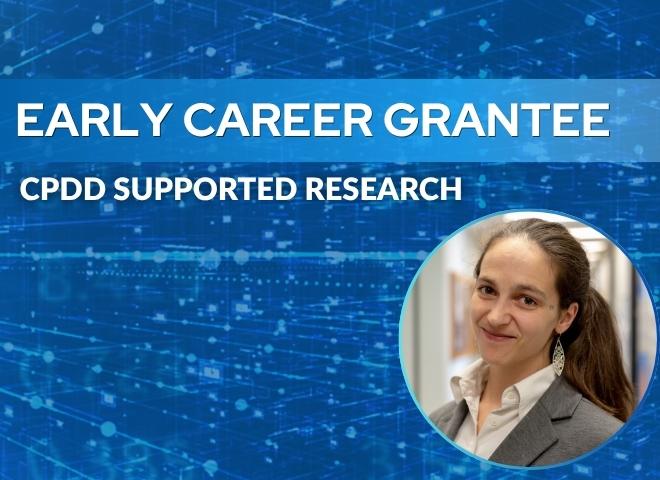
CPDD is pleased to spotlight the first recipients of its Early Career Investigator Grants who have completed their research and will present their findings as a poster at the 88 Annual Scientific Meeting. The Early Career Investigator Grant is an award created to support promising early career researchers advancing substance use disorder research.
2024 Recipient
Martha Tillson, Ph.D.
University of Kentucky, Department of Sociology
Multidimensional Substance Use Stigma: Characterizing Experiences and Stigma Management Strategies
Briefly tell us about your research and the problem or question you’re trying to address.
Stigma related to substance use is a well-recognized barrier to accessing health services and social supports, treatment initiation and retention, and recovery writ large; however, little research has focused on dimensional factors that might modify how individuals experience and respond to stigma — factors such as demographics, background characteristics, substance use patterns, and recovery pathway. My CPDD Early Career Grant involved purposeful recruitment of a diverse sample of individuals with a history of problematic substance use to examine variations in experiences of stigma and stigma management strategies, using a mixed methods approach.
What did the Early Career Grant make possible for you?
The Early Career Grant made it possible for me to explore a complex topic using a methodology that allowed my participants to share their experiences in their own words. It allowed me to gather preliminary data that will support multiple future grant proposals, to build on existing quantitative stigma measurement approaches, and to enhance my own expertise in an area about which I am passionate. Lastly, it allowed me the opportunity to provide collaborative mentorship for three undergraduate students who completed independent research projects using data from this pilot study (and two more students who have independent work in progress).
In what ways did that support shape the direction of your work or your development as a researcher?
The support from the CPDD Grant has had a tremendous and positive impact on my development as a researcher — substance use-related stigma is an area that I have long been interested in, both as a researcher and as a person in long-term recovery: I have seen first-hand the detrimental impacts of stigma, but also the resilience of so many individuals who have overcome stigmatizing interactions and situations. This project has allowed me to build my scientific expertise around stigma and provided preliminary data that I will use to support a NIH/NIDA R34 proposal focused on the development of a peer-grounded stigma intervention but has also inspired me to explore myriad new aspects of intersectional substance use stigma in further detail.
What impact from the grant are you most proud of at this point?
I'm so proud of so many aspects of this grant — I'm proud of the thoughtful responses provided by each of our participants, who reflected so critically on their own experiences and inspired me to think about substance use-related stigma in even more nuanced and complex ways. I'm proud of the impact for the community, in that we had the opportunity to highlight stigma as a critical issue in conversations about recovery and well-being. Lastly, I'm perhaps most proud of the impact for my students: the breadth and depth of the data collected has offered a multitude of opportunities for undergraduates to build their understanding of stigma, develop independent research questions, and present their work to scientific audiences. For myself, exposure to research as an undergraduate had a significant impact on my career trajectory, and I'm honored to be able to provide that opportunity for other junior scholars.
See more on Dr. Tillson’s work during the Monday poster Session at CPDD2026.